Jeff Selser / Selser Media LLC - helps businesses and agencies move from proprietary web platforms to open source infrastructure that they actually own — using AI to make migration faster and more affordable than it's ever been. Contact Me
The layoffs are real. The pivot is real. Here's what it means for your site — and what to do about it.
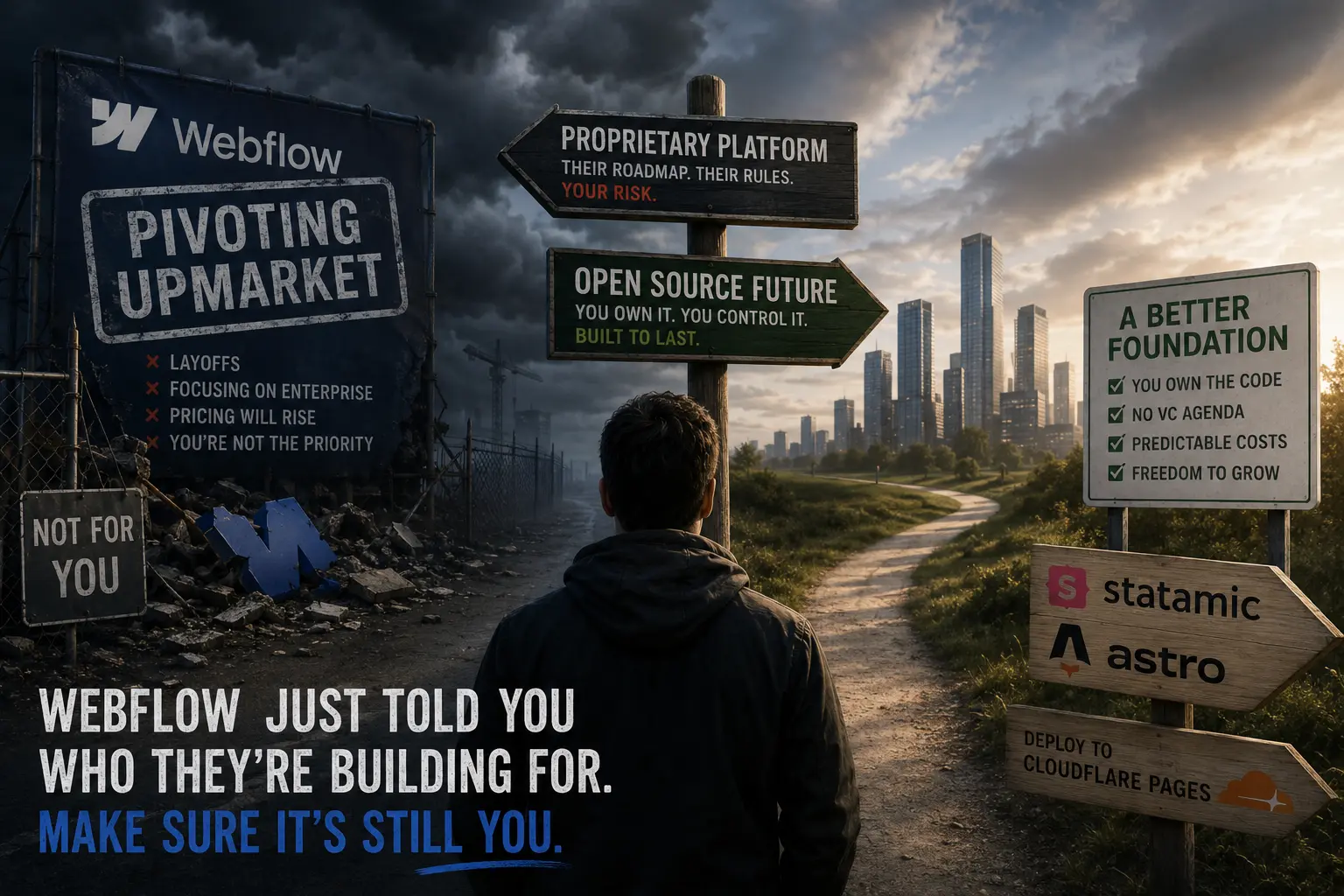
Webflow announced significant layoffs this week, and CEO Linda Tong published a message framing the move as a necessary step toward building an "agentic web marketing platform" for teams that are "serious about their digital experience."
It's a well-written post. It's also a clear signal.
If you're a small business, a growing company, or an agency managing sites for clients who just need a reliable, fast, well-maintained web presence — Webflow is telling you, politely but plainly, that they're optimizing for someone else now.
What Webflow's Announcement Actually Says
Read past the corporate language and a few things stand out:
They're moving upmarket. The language throughout — "marketing teams," "growth engine," "agentic platform," "enterprise" — describes a product direction aimed at larger organizations with bigger budgets and more complex needs. That's a legitimate business strategy. It's also a departure from the Webflow that many of us built businesses on.
They're acknowledging the low end is gone. The announcement explicitly notes that "AI tools and lightweight builders are providing a faster path to launch for those with simple website requirements." Translation: they're okay losing that segment of the market. If your clients are in that category, Webflow has effectively priced them out of the roadmap.
Layoffs affect product quality — at least for a while. Significant restructuring almost always means slower support response times, slower bug fixes, and less documentation maintenance for 12 to 18 months while teams rebuild and restabilize. That's not speculation — it's a consistent pattern across the industry.
The Deeper Problem With Proprietary Platforms
The Webflow announcement is new. The underlying risk isn't.
When your site — or your client's site — lives inside a proprietary hosted platform, you don't fully own it. You're licensing access to it. The platform controls:
- Pricing. Which can change, and historically does when companies pursue enterprise positioning.
- Features. Which get gated, renamed, sunset, or moved to higher tiers.
- Export limitations. Webflow's exported code is clean HTML/CSS, but it doesn't export CMS content in a way that makes migration easy.
- The roadmap. Which now points somewhere most small-to-mid-market clients aren't going.
This isn't unique to Webflow. It's the nature of the model. But Webflow's announcement makes it more visible than it's been in years.
A Better Position for the Future
I've been building on the web for a long time, and about three years ago I made a deliberate decision to move my clients off Webflow — keeping only one — and shift to open source platforms. That decision looks better now than it did then.
Here's why open source is a stronger foundation:
You own the code. Completely.
On platforms like Statamic or Astro, the codebase belongs to your client. It lives on infrastructure they control, migrates wherever they need it to go, and isn't subject to pricing changes or platform pivots.
The software doesn't have a VC-funded agenda.
Statamic has been quietly, consistently excellent for over a decade — a Laravel-based CMS built by a small, focused team that has never chased an acquisition or a Series C. Astro is a modern open source framework with a fast-growing community, exceptional performance characteristics, and deep integration with Cloudflare Pages for deployment — giving you edge hosting, CDN, and serverless capabilities without locking into any one vendor.
Neither of these platforms is going to pivot upmarket and leave your clients behind.
AI has flipped the cost equation.
This is the part that changes the math right now. A few years ago, migrating a client off Webflow required significant time investment that was hard to justify for most projects. Today, with AI tools, I can move through templating, content migration, and component builds dramatically faster than before. Astro in particular pairs well with AI-assisted development — its component model and clean HTML-first architecture make it straightforward to build with, even without years of framework experience.
The friction cost of migration has dropped. The risk cost of staying on a platform mid-pivot has increased. Those two curves have crossed.
The cost model scales with you, not against you.
Webflow's per-site pricing compounds as clients grow. Self-hosted or edge-deployed open source has fixed or much more predictable infrastructure costs. Cloudflare Pages, for example, has a generous free tier and low-cost scaling — a meaningful contrast to Webflow's per-site seat model.
Choosing the Right Tool for the Job
Not every migration looks the same, and not every platform is right for every client. Here's a rough way to think about it:
Statamic is the better fit when your client needs a full content management experience — editors logging in regularly, managing blog posts, updating product pages, building out CMS-driven content. It's a mature, fully-featured CMS with a polished control panel and flexible content modeling. It requires PHP hosting, but setup is well-documented and manageable.
Astro is the better fit when performance and simplicity are the priority — a marketing site, a portfolio, a content site that doesn't need heavy CMS editing workflows. Astro sites are fast by default (built around a "zero JS by default" philosophy), easy to deploy on Cloudflare Pages, and increasingly accessible to build with AI assistance even if raw HTML and component structure are new territory for you.
Both are genuinely good options. The right choice depends on the client's needs, not on which platform is trendier.
What Should You Do Right Now?
If you're a business owner on Webflow: You don't need to panic, but you should have a plan. Understand what migration would look like for your site. Know your options before you're forced into them by a pricing change or a feature removal.
If you're an agency managing Webflow sites: Your clients are going to start asking questions. Be the one who already has the answers. The agencies that navigate this well will deepen client relationships. The ones that don't will lose sites to whoever does.
If you've been on the fence about migrating: The fence just got less comfortable.
What Comes Next
I'll be publishing a series of posts here covering the practical side of this shift:
- Statamic vs. Astro — choosing the right platform for your migration — honest tradeoffs based on client type and use case
- What migration actually looks like — the workflow I use, what AI handles, what still needs human judgment
- Deploying on Cloudflare Pages with Astro — why this stack is worth understanding right now
- Building a maintenance workflow that actually works — so your clients aren't calling you every time something breaks
If you want to talk through your specific situation — whether you're a business owner wondering about your site, or an agency trying to figure out your next move — I'd like to help.
I've been in this industry a long time. I've watched platforms rise and pivot and leave good people holding the bag. You don't have to figure this out alone.
Jeff Selser / Selser Media LLC - helps businesses and agencies move from proprietary web platforms to open source infrastructure that they actually own — using AI to make migration faster and more affordable than it's ever been.